
What Life Insurance Costs by Occupation in Australia (2026)
Updated: 6 days ago
Written by Christopher Hall, AdvDipFP | Authorised Representative, AFSL 526688 | Updated September 2026
Occupation is the variable most often described and least often priced. On 10 September 2026, Arrow Equities quoted an identical package of personal insurance — $1,000,000 of life cover, $1,000,000 of any-occupation TPD, income protection paying $5,800 a month on a 90-day wait and 5-year benefit period, and $100,000 of trauma cover — for five occupations, at three ages, across an eleven-insurer panel, on a single day. Holding every other variable constant is what turns "occupation affects your premium" into a number.
The result on the leading insurer at age 40: a carer's $1,000,000 of any-occupation TPD cost $61.82 a month against a school teacher's $30.91 — exactly twice — and income protection cost $101.84 against $42.14, about 2.42 times. Life cover and trauma cover priced identically to the cent for both occupations, at $24.91 and $18.44. The same two multipliers held at age 30 and again at age 50, and held a month earlier on the 5 August run.
That is the finding this page exists for: occupation loading is not a general uplift on "insurance for carers" or "insurance for tradespeople". It is a specific multiplier applied to specific covers, and on the leading insurer it lands entirely on the two covers that pay when someone cannot work — leaving untouched the cover that pays when someone dies. These are stepped premiums on representative profiles quoted on one day; individual circumstances change the price.
How this was measured, and why the method is the point
Arrow Equities is a specialist life risk advice practice operating under AFSL 526688. Each month it runs a standardised comparison across its eleven-insurer panel — AIA, TAL, Acenda, Zurich, MetLife, OnePath, NEOS, PPS, ClearView, Encompass and Futura — for a set of representative occupation profiles, and publishes the result.
The comparison is built on one rule: everything except the tested variable is held constant. Every occupation on this page is quoted at the same age, the same non-smoking status, the same $100,000 income, the same four covers at the same sums insured, the same 90-day waiting period, the same 5-year benefit period, the same premium structure, and on the same day. Bundle discounts are applied where available; health, platform, preferred-adviser and couples discounts are not.
That last exclusion matters more than it sounds. Two quotes were set aside this month for it — AIA's discounted package and Encompass's Healthy Life variant, both health-rewards programmes — because a health-based discount prices the person, not the occupation, and including one would contaminate the very comparison the page is making.
This is what allows a multiplier to be stated rather than an adjective. An aggregator publishing average premiums cannot isolate occupation, because nothing else in its dataset is held still — which is the difference between a range and a like-for-like policy comparison. A regulator can say occupation affects price; it does not quote. The multipliers below exist because eleven insurers were asked the same question about five different people on the same morning.
What occupation actually costs — the loading, cover by cover
All figures below are quoted with Zurich, the most competitively priced insurer on this panel for four of the five occupations on 10 September 2026, for a 40-year-old non-smoker on a $100,000 income. The teacher is used as the reference because it is the lightest-rated of the five.
Cover, age 40 | Teacher | Sales assistant | Nurse | Electrician* | Carer |
Life — $1,000,000 (super) | $24.91 | $24.91 | $24.91 | $28.76 | $24.91 |
TPD any-occupation — $1,000,000 (super) | $30.91 | $30.91 | $46.36 | $62.04 | $61.82 |
Income protection — $5,800/mo (super) | $42.14 | $59.70 | $87.79 | $64.90 | $101.84 |
Trauma — $100,000 (own name) | $18.44 | $18.44 | $18.44 | $14.95 | $18.44 |
Stated as multipliers against the teacher:
Against the teacher, age 40 | Sales assistant | Nurse | Electrician* | Carer |
Life cover | identical | identical | ×1.15* | identical |
TPD any-occupation | identical | ×1.50 | ×2.01 | ×2.00 |
Income protection | ×1.42 | ×2.08 | ×1.54 | ×2.42 |
Trauma | identical | identical | ×0.81* | identical |
The electrician profile is male; the other four are female. Life cover and trauma cover are priced on age and sex, so the two figures marked with an asterisk reflect that difference rather than occupation — which is precisely why they move for him and stay identical to the cent across the four female profiles. His TPD and income-protection multipliers are directly comparable, because those two covers are the ones occupation actually moves.*

Four things in that table are worth stating on their own.
A sales assistant's TPD costs exactly the same as a teacher's. On this insurer's rate table the two sit in the same TPD risk class, and the entire difference between them — $17.56 a month — sits in income protection alone. So "occupation loading" is not one uplift applied to a package. For some occupations it touches two covers; for others, one.
Life cover and trauma cover did not move at all. Across a classroom teacher, a retail sales assistant, a registered nurse and a carer, $1,000,000 of life cover cost $24.91 a month for every one of them, and $100,000 of trauma cover cost $18.44 for every one of them. To the cent, on the same day. The loading follows the risk it is meant to price: a care role carries more exposure to the injury and illness that stop someone working than a classroom role does, and no more exposure to the risk of dying. Life, TPD and income protection are all held inside superannuation on these quotes; trauma is held personally, because critical illness cover generally cannot sit inside super.
An electrician and a carer sit in effectively the same TPD class. His any-occupation TPD priced at ×2.01 against the teacher and hers at ×2.00 — a difference of four-tenths of one percent, on the same insurer, the same day. Their income protection is not remotely the same: ×1.54 against ×2.42, a 57% gap. So the two most physically demanding occupations on this panel are rated as near-equivalent risks for permanent disablement and as very different risks for time off work through illness or injury. Those are different questions, and this insurer answers them differently.
The multipliers are stable. The carer's ×2.00 on TPD and ×2.42 on income protection held at age 30 ($68.51 against $34.25; $76.31 against $31.58) and at age 50 ($146.77 against $73.39; $216.35 against $89.52). They also held across a month: the same two figures were recorded on 5 August 2026 and reproduced on 10 September. A multiplier that survives three ages and two monthly runs is a property of the rate table, not an artefact of one quote.
The result that contradicts the assumption
The common expectation is that trades carry the heaviest occupation loading. On this panel, on this day, they did not.
The electrician's income protection cost $48.84 a month at age 30 against the carer's $76.31 — 36% less — while his TPD was only 2.1% higher than hers. Care work was the more heavily loaded occupation of the two on the cover that matters most to the total.
That is not a claim about which job is more dangerous. It is a claim about what an insurer's claims experience shows about which duties produce income-protection claims — and on this panel, sustained physical care work priced above electrical trade work.
Insurers do not agree on the shape of the loading
The multipliers above are Zurich's. Quoted on the same day for the same two occupations, ClearView priced the loading on a completely different architecture:
Carer against teacher, age 40 | Zurich | ClearView |
Life cover | identical | ×1.081 |
TPD any-occupation | ×2.00 | ×1.081 |
Trauma | identical | ×1.081 |
Income protection | ×2.42 | ×3.50 |
Zurich exempts two covers entirely and loads the other two heavily. ClearView applies a near-identical uplift of about 8% to life, TPD and trauma alike — 1.081, 1.081 and 1.081 — and puts almost the whole occupation difference into income protection at three and a half times. Both structures are internally consistent and both held at ages 30 and 40. Neither is "the market rate" for a carer.
The practical consequence is not abstract. A carer comparing insurers is not choosing between higher and lower versions of the same number — the insurers disagree about which covers a care role should be loaded on at all. That is why a package that is competitive on one insurer's structure can be uncompetitive on another's for the identical person, and why comparing a single cover in isolation is unreliable for this occupation in particular.
The layer underneath: stamp duty is not the same for two people in the same job
Two workers in the same occupation, on the same cover, can carry different duty. Quoted on 10 September 2026 across the five profiles, the duty on this package was calculated as:
State | Basis | Covers attracting no duty |
New South Wales | 5% of the income-protection premium | life, TPD, trauma |
Victoria | 10% of the TPD, income-protection and trauma premiums, split by where each cover is held | life |
Queensland | 9% of the income-protection premium plus 9% of the trauma premium, split by where each is held | life, TPD |
Two consequences follow. First, an insurer that prices income protection expensively is charged for it twice — once in the premium, and again in the duty calculated on it. On the NSW profiles, a $23.86 gap in income protection carried a further $1.19 a month of duty with it.
Second — and this one is genuinely obscure — the insurer's own domicile can change the answer. Two of the eleven panel insurers are Victorian-based, and in that scenario no duty applies to the own-name trauma line, where the other nine charge it. It is a $2 to $4 a month difference that appears nowhere in a cover-by-cover comparison because it lands only in the total.
So the duty line has four variables behind it: the policyholder's state, the type of cover, whether the cover is held inside superannuation or personally, and the insurer's own domicile. Comparing two occupations across state lines without accounting for it produces a difference that is not an occupation difference at all.
Age moves the price more than occupation does — and not evenly
Occupation sets the multiplier. Age sets the base it multiplies.
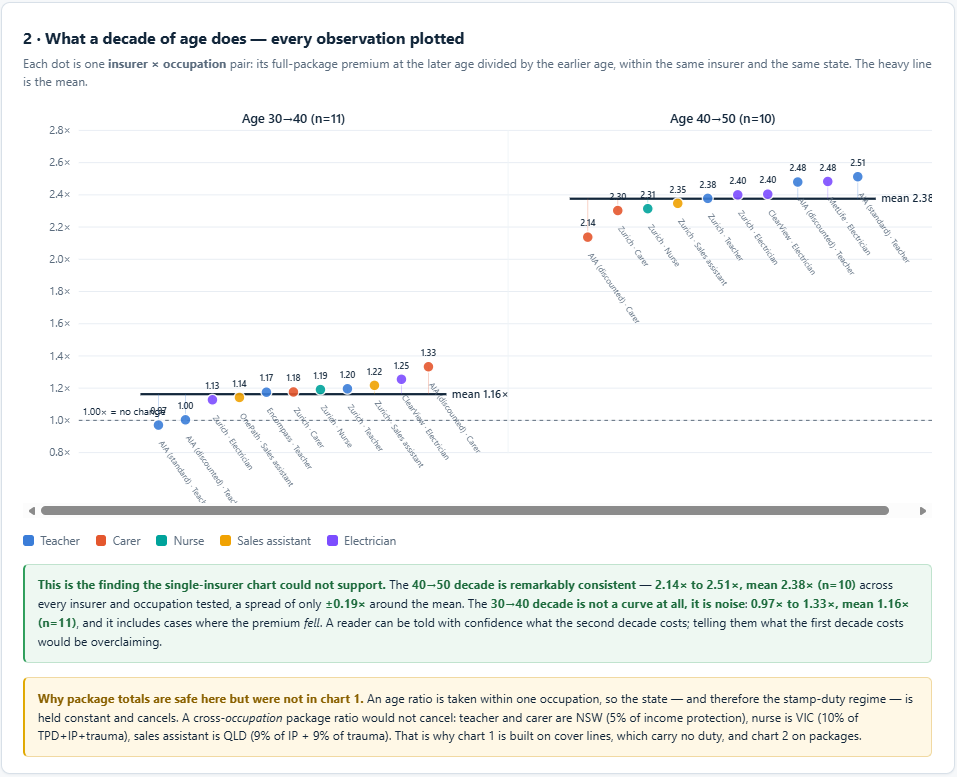
Quoted with the same insurer on the same day for the teacher profile, the full package cost $99.06 a month at age 30, $118.51 at age 40 and $281.83 at age 50. The first decade added 19.6%. The second added 137.8% — seven times the increase for the same ten years.
And the covers do not move together. Between 40 and 50 on that profile, trauma cover rose 192% and TPD 137%, against 143% for life and 112% for income protection. Across the full twenty years trauma rose ×4.20 and TPD ×2.14 — the same package, the same insurer, the same day.
Because these are stepped premiums, that acceleration is built into the contract rather than imposed by the insurer — a separate thing from a repricing, and worth telling apart when a premium increase arrives.
One line runs backwards. On this panel two insurers priced $1,000,000 of any-occupation TPD lower at 40 than at 30 — Zurich by 9.8% and AIA by 49.1% — while others rose with age as expected. It is not an error in the quote, and it has now appeared in two consecutive monthly runs across three occupation classes and both sexes. It is a property of how each insurer's rate table is built cell by cell, not of the person being quoted.
What an adviser reads into these numbers
Numbers of this kind are only useful alongside the reasoning that explains what to do about them. These are Christopher Hall's observations from more than 500 life insurance policy reviews.
"Asked which insurer is best, my answer is that it depends on age, occupation, risk category, level of cover and state — and the answer changes month to month, which is why the comparison is re-run rather than assumed." That is the whole case for measuring occupation rather than describing it: the loading is one input into an answer with five inputs, and four of the other five move.
Occupation is not fixed, and neither is the risk category attached to it. A pay rise, a change of duties, or a move from hands-on work into supervision can move a policyholder into a different risk category and reduce the premium on cover they already hold — where the structure is handled correctly. It is one of the few levers that reduces a premium without reducing cover, and it is almost never actioned, because nothing prompts a policyholder to tell their insurer that their job changed.
Health is portability, and portability is price. Whether a policyholder can act on any of this depends on whether they can move. Health determines that: compromised health means limited flexibility, limited flexibility means reduced portability, and reduced portability means wearing whatever the current insurer charges. It is also getting harder to qualify for cover than it was a decade ago, and harder again after a serious diagnosis. A favourable occupation loading is only worth something to someone who can still qualify for the policy that offers it.
Every insurer is adjusting its own pricing curve continuously, and on its own timetable — across age bands, occupation classes and cover types. A comparison on any one date is a snapshot of eleven curves mid-movement, which is why a ranking reorders without any insurer having done anything unusual, and why the series matters more than any single month's table. On this panel in September, one insurer repriced two cells of its rate table by about 11% and left an adjacent cell untouched on the same day.
And the definition can matter more than the occupation. "TPD held inside super is written on an any-occupation basis. For a specialist doctor or a tradesperson, that is a materially different promise from own-occupation cover — and the same gap exists on income protection for anyone whose income rests on years of specific training." Every TPD figure on this page is any-occupation, which is the cheaper definition and the one most Australians hold through superannuation — often as default cover they never chose, and often for less than they assume. What TPD actually pays on, and when, is set out in what TPD insurance is. The own-occupation alternative costs more and pays on a more generous test.
One further pattern worth knowing, because it moves in the opposite direction to everything above: over the last twelve months several of the largest insurers have sharply repriced their own-occupation TPD cover, a shift Christopher Hall attributes to the escalation in mental-health TPD claims. The tell is visible in the quotes — price own-occupation cover and some of the largest insurers rank last, second-last and third-last; switch the definition to any-occupation, where a mental-health claim is far harder to establish, and the same insurers move into the top five. That is a product and pricing decision, not a coincidence, and it means the occupation loading and the definition interact.
Two people, same age, same cover, same day
A 40-year-old carer and a 40-year-old teacher, both female, both non-smokers, both on $100,000. Identical cover, quoted the same morning with the same insurer. The teacher pays $118.51 a month; the carer pays $212.10. The $93.59 difference is not spread across the package — $30.91 of it is TPD and $59.70 is income protection, and not one cent of it is life cover or trauma cover. If the carer compared only life premiums across insurers — the single figure most online quote funnels lead with — she would see no occupation effect at all and conclude her job does not affect her cover. It affects it by 79%.
A 30-year-old electrician and a 30-year-old carer. The assumption is that the trade is the riskier job. On income protection the carer pays $76.31 and the electrician $48.84 — she pays 56% more than he does for the cover that replaces income. On TPD they are within 2% of each other.
A 40-year-old sales assistant deciding whether her job matters at all. Her life cover, her TPD and her trauma cover are priced identically to a teacher's, to the cent. Only income protection differs, at $59.70 against $42.14. For her, "does my occupation affect my premium" has a precise answer: on three of four covers, no — on the fourth, by 42%.
The same package, priced for each occupation
Each occupation below is a full monthly comparison on this standardised package, updated monthly and showing every insurer's figures:
What life insurance costs a teacher — the lightest-rated of the five
What life insurance costs a sales assistant — same TPD class as a teacher, loaded only on income protection
What life insurance costs a nurse — and how Victorian stamp duty changes the total
What life insurance costs an electrician — the trade that prices below the care role
What life insurance costs a carer — the most heavily loaded of the five
Beyond the five priced profiles, Arrow Equities publishes occupation-specific guidance for several professional groups where the cover question turns on the nature of the work rather than its physical risk — medical professionals, engineers, finance professionals and scientists. For those occupations the definition and the benefit period usually matter more than the loading, because the income being protected rests on years of specific training.
For the same panel ranked by insurer rather than by occupation, see Australia's most competitively priced life insurers. For what a review of existing cover involves, see the insurance premium review process, and for why long-held policies drift above the market, the loyalty tax.
Published case studies show the same mechanics on real cover, across a registered nurse, a carpenter and a chef.
How this comparison was run
The figures are an illustrative comparison for representative profiles, quoted on 10 September 2026 using adviser quotation software across the Arrow Equities eleven-insurer panel. Each occupation is priced at ages 30, 40 and 50 on the same date, with the same product suite, cover amounts, waiting period and benefit period, varying only occupation and age.
Bundle discounts were applied where available; no health, platform, preferred-adviser or couples discounts were applied, and no individual underwriting loadings or exclusions are reflected. Quotes on a shorter income-protection benefit period are not directly comparable and are excluded rather than ranked. Premiums are stepped, so they rise each year with age. Where a figure is described as identical across occupations, it reconciled to the cent.
The profiles are: teacher (female, NSW), carer (female, NSW), nurse (female, VIC), sales assistant (female, QLD) and electrician (male, NSW) — each a non-smoker on a $100,000 income. $100,000 is a deliberate cross-occupation constant rather than a claim about typical earnings in each role; each occupation page sets out how that compares to real median earnings for that job.
This is a price comparison across one panel, not a whole-of-market survey and not a quality assessment. Definitions, benefit periods, exclusions and structure matter as much as price — as does the tax treatment, since income protection premiums are generally deductible where the other three covers are not, and how a TPD claim is assessed turns on the definition rather than the premium — and an individual's health, exact duties and cover needs change the answer. To get quotes on actual circumstances → is the only way to confirm a real price.
Remember that past performance is no guarantee of future results, and pricing changes regularly.
Frequently asked questions
Does your occupation affect life insurance premiums in Australia?
Yes, but not in the way most people expect, and not on every cover. Quoted on 10 September 2026 with the same insurer on the same day, $1,000,000 of life cover cost $24.91 a month for a 40-year-old female non-smoking teacher, sales assistant, nurse and carer alike — identical to the cent — and $100,000 of trauma cover cost $18.44 for all four. The difference between them sat entirely in TPD and income protection, the two covers that pay when someone cannot work.
How much more does a carer pay for life insurance than a teacher?
On the same insurer, same day and identical cover at age 40, a carer's full package cost $212.10 a month against a teacher's $118.51 — 79% more. Broken down: any-occupation TPD cost exactly twice as much ($61.82 against $30.91) and income protection 2.42 times as much ($101.84 against $42.14), while life cover and trauma cover priced identically for both.
Which occupation pays the most for income protection?
Of the five occupations Arrow Equities prices on a standardised package, the carer profile carried the highest income-protection premium on 10 September 2026 — $101.84 a month at age 40 against $42.14 for a teacher, $59.70 for a sales assistant, $64.90 for an electrician and $87.79 for a nurse. Care work priced above the electrical trade on this cover, which runs against the common assumption that trades are the most heavily loaded.
Do tradespeople pay more for life insurance than office workers?
Not uniformly. On the 10 September 2026 comparison, a 30-year-old electrician's income protection cost $48.84 a month against a carer's $76.31 — 36% less — and his TPD was only 2.1% higher than hers. Occupation loading follows an insurer's claims experience for the duties involved, not a general sense of which job sounds more dangerous.
Which covers does occupation actually change the price of?
On the leading insurer for these profiles, occupation moved TPD and income protection and did not move life cover or trauma cover at all. That is consistent with what each cover pays for: TPD and income protection respond to being unable to work, which is where duties matter, while life cover responds to death, which they do not affect in the same way. Other insurers apply the loading differently.
Do all insurers load occupation the same way?
No, and the difference is structural rather than a matter of degree. Comparing a carer against a teacher on 10 September 2026, Zurich left life and trauma untouched and loaded TPD by 2.00 times and income protection by 2.42 times; ClearView applied a uniform uplift of about 8% to life, TPD and trauma alike and loaded income protection by about 3.50 times. Both are internally consistent; they simply disagree about which covers a care role should be loaded on.
Is life insurance cheaper for a low-risk occupation?
On these quotes the lightest-rated occupation of the five was the school teacher, whose full package at age 40 was $118.51 a month. But "low-risk occupation" describes the loading, not the price: age moved the same package from $99.06 at 30 to $281.83 at 50, a far larger swing than occupation produced between any two of these five jobs at a single age.
How much does life insurance cost for a nurse in Australia?
For a 40-year-old female non-smoking registered nurse in Victoria on a $100,000 income, the full package of $1,000,000 life, $1,000,000 any-occupation TPD, $5,800 a month of income protection and $100,000 of trauma cover was quoted at $192.76 a month on 10 September 2026 with the most competitively priced insurer on a like-for-like basis. Full figures for every insurer are on the nurse comparison page.
Why do two people in the same job pay different stamp duty?
Because duty is levied by state on a state-specific basis, and the basis differs on which covers it applies to. On these quotes, New South Wales duty was 5% of the income-protection premium with the other three covers exempt; Victoria charged 10% across TPD, income protection and trauma with life exempt; Queensland charged 9% on income protection and 9% on trauma. The insurer's own domicile can also change it — two panel insurers are Victorian-based and charged no duty on the own-name trauma line.
Does an occupation change move an existing premium?
It can. A pay rise, a change of duties or a move from hands-on work into supervision can move a policyholder into a different risk category and reduce the premium on cover they already hold, where the structure is handled correctly. It is one of the few levers that lowers a premium without lowering cover — and it is rarely actioned, because nothing prompts a policyholder to tell an insurer their job has changed. A periodic premium review is where it usually surfaces.
Is TPD inside superannuation the same for every occupation?
The definition is the same and the consequence is not. TPD held inside super is written on an any-occupation basis, and as Christopher Hall puts it: "For a specialist doctor or a tradesperson, that is a materially different promise from own-occupation cover — and the same gap exists on income protection for anyone whose income rests on years of specific training." Every TPD figure on this page is any-occupation, which is the cheaper definition and the one most Australians hold through super.
Why has own-occupation TPD become more expensive?
Over the last twelve months several of the largest insurers have sharply repriced their own-occupation TPD cover, a shift Christopher Hall attributes to the escalation in mental-health TPD claims. The pattern is visible in the quotes: price own-occupation cover and some of the largest insurers rank last, second-last and third-last; switch to an any-occupation definition, where a mental-health claim is harder to establish, and the same insurers move into the top five.
How often do occupation-based premiums change?
Every insurer adjusts its own pricing curve continuously and on its own timetable, so any single comparison is a snapshot. In September 2026 one insurer repriced two cells of its rate table by about 11% while leaving an adjacent cell identical to the cent, on the same day. That is why Arrow Equities re-runs this comparison monthly rather than treating a result as standing.
Can I get a cheaper premium by describing my occupation differently?
An occupation must be described accurately — a misdescription is a misrepresentation and can affect a claim. What is legitimate is making sure the description is precise: occupation classes turn on actual duties, hours and whether work is manual, and a role described loosely can be rated more heavily than the duties warrant. That is a conversation to have with an adviser at application, not an adjustment to make afterwards.
Which insurer is best for my occupation?
Arrow Equities does not name any insurer as best. Asked the question, Christopher Hall's answer is that it depends on age, occupation, risk category, level of cover and state — and that the answer changes month to month, which is why the comparison is re-run rather than assumed. Read as most competitively priced for a specific profile on a specific date, Zurich led four of the five occupations on 10 September 2026, with ClearView leading the fifth at age 30 — the full panel ranking is published as Australia's most competitively priced life insurers.
What income was used for these comparisons?
$100,000 a year for every occupation, held constant so that income protection is sized identically and the occupation is the only variable moving. That is a deliberate comparison device rather than a claim about typical earnings — for some of these occupations $100,000 sits above the real median and for others it is close to it, and each occupation page sets out how it compares.
Book a quick review with an adviser
Book a quick review with an adviser now. A review checks what cover is actually needed for a specific occupation and set of duties, whether it is held in the most cost-effective structure across super and personal ownership, and how current pricing compares across the insurer panel.
About the Author
Christopher Hall, AdvDipFP, is the principal financial adviser at Arrow Equities and an Authorised Representative under AFSL 526688. He has completed more than 500 life insurance policy reviews for Australian families, with a specialisation in life risk insurance.
Insurance product providers reviewed for this analysis (10 September 2026)
The premiums on this page were compared across the Arrow Equities insurer panel. Each provider reviewed for this analysis is listed below:
A full insurance premium review compares an individual's actual cover against this panel.
Sources
Premium figures: Arrow Equities adviser quotation software comparison across the eleven-insurer panel, run 10 September 2026, on the five representative occupation profiles described above, at ages 30, 40 and 50. Every quoted total was reconciled (cover lines plus any policy fee plus stamp duty against the stated total) before use. Health-based discounts (AIA's discount stack and Encompass's Healthy Life variant) and short-benefit-period income-protection quotes were excluded rather than ranked.
Prior-month comparison for the stability check: same panel and profiles, run 5 August 2026.
Stamp duty: levied per state; the bases described are those applied in the quotes for NSW, VIC and QLD on this cover set.
Practitioner observations on occupation risk categories, own-occupation TPD repricing, the mental-health claims driver, and the relationship between health, portability and price: Christopher Hall, AdvDipFP, Authorised Representative, AFSL 526688, drawing on more than 500 life insurance policy reviews.
Arrow Equities, AFSL 526688, ABN 87 645 284 680.
Educational Disclaimer: This content is for educational purposes only and does not constitute financial advice. Past performance is no guarantee of future results.
The information, opinions and other materials appearing on the Web Site are of a general nature only and shall not be construed as advice. Arrow Equities is a trading name of Rose Bay Equities Pty Ltd, AFSL 526688, ABN 87 645 284 680. This general information is educational only and not financial advice, recommendation, forecast or solicitation. Arrow Equities accepts no responsibility for the accuracy or completeness of the information, opinions or other materials provided on or accessible through the Web Site. The Web Site has not been prepared with reference to your individual financial or personal circumstances. You should not rely on any advice in this Web Site without first seeking appropriate professional, financial and legal advice. Further, where Arrow Equities makes third party material available or accessible through the Web Site you acknowledge that Arrow Equities is a distributor and not a publisher of that content and that its editorial control is limited to the selection of those materials to make available. We accept no liability for any loss or damages arising from use.


Comments